Ultimate Pricing Guide for Bookkeeping Cost Australia 2026: Real Hourly Rates & Fees
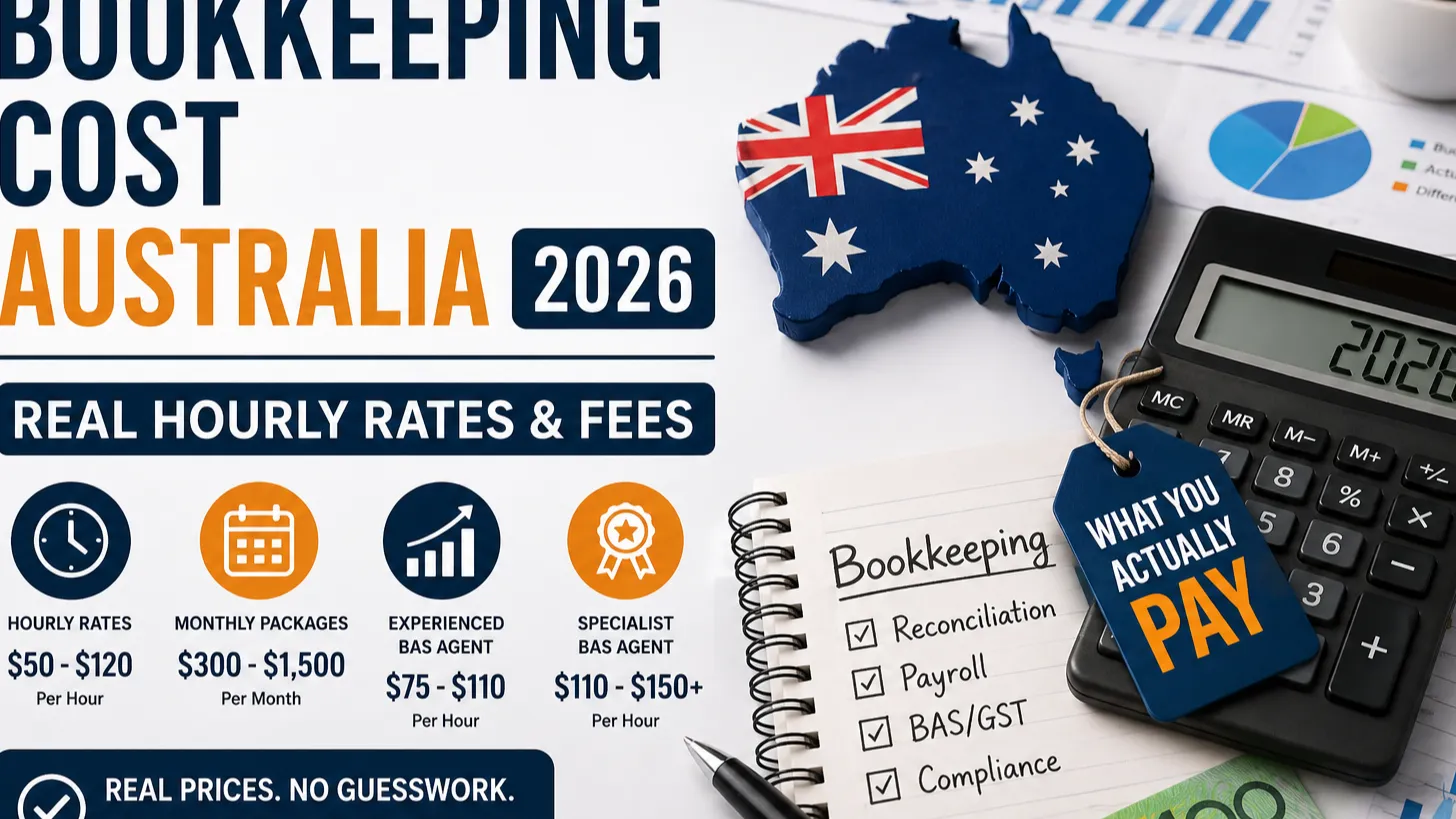
Table of Contents
- Bookkeeping vs Accounting – Are They the Same Thing?
- How Much Does a Bookkeeper Cost in Australia in 2026?
- How Much Does a Bookkeeper Charge Per Hour in Australia?
- The Most Common Pricing Confusion- Employee Wage vs Service Rate
- What’s Actually Included in a Bookkeeping Engagement?
- Hourly vs Fixed Monthly vs Per-Transaction vs Subscription- Which Pricing Model Fits Your Business?
- What Drives Your Bookkeeping Cost? (7 Real Drivers)
- Bookkeeping Software Costs in Australia (2026)
- Bookkeeping Cost by State- Metro vs Regional in 2026
- What Is the Hourly Rate for Bookkeepers in Melbourne?
- Bookkeeping Cost by Business Type
- Bookkeeping Cost Calculator Australia: Estimate Your 2026 Monthly Fee
- Payroll, BAS, and STP- Add-On Costs Explained
- In-House vs Freelance BAS Agent vs Bookkeeping Firm- True Cost Comparison
- Are Bookkeeping Fees Tax Deductible in Australia?
- Cash vs Accrual Bookkeeping- Which Applies to Your Business?
- How to Reduce Your Bookkeeping Costs Without Cutting Corners
- Red Flags When Choosing a Bookkeeper
- How to Get a Bookkeeping Quote (and What It Should Include)
- 7 Questions to Ask Before Hiring a Bookkeeper
- Bookkeeping Trends Affecting Pricing in 2026
- Final Thoughts- What Should You Actually Pay in 2026?
- Frequently Asked Questions
- About the Author
- Methodology and Sources
Bookkeeping in Australia costs $50 to $120 per hour, or $300 to $1,500 per month for a fixed monthly package in 2026. These bookkeeping prices Australia-wide reflect 2026 market data from BAS Agents, accounting firms, and subscription providers — whether you’re comparing bookkeeping cost per hour or bookkeeping cost per month, the same five drivers shape your final number (transaction volume, payroll complexity, BAS frequency, software stack, and TPB registration tier). Bookkeeping rates per hour Australia have risen roughly 8–12% since 2024 as Payday Super, STP Phase 2, and Professional Indemnity insurance costs have flowed into agent rate cards. Data-entry-only services from unregistered operators sit lower at $35–$50/hr, while specialised BAS Agents handling trust accounting, NDIS compliance, or system migrations charge $110–$150+/hr. Your final bookkeeping cost depends on transaction volume, payroll complexity, and crucially, whether the practitioner is legally registered with the Tax Practitioners Board (TPB) to lodge your BAS. All fees from a GST-registered Australian bookkeeper are quoted either inclusive of GST or with 10% GST added to the line. Before comparing quotes, verify the bookkeeper’s BAS Agent number on the TPB public register at tpb.gov.au– anyone charging for BAS services without registration is committing an offence under the Tax Agent Services Act 2009.
Bookkeeping vs Accounting – Are They the Same Thing?
No, and confusing the two is one of the most expensive mistakes I see Australian small business owners make. Bookkeepers and accountants do different work, charge different rates, and answer to different parts of the regulatory framework. Most established businesses end up using both, for very different parts of the financial year.
Bookkeeping is the day-to-day work: bank reconciliation, transaction coding, payroll processing, BAS preparation, invoice management, and supplier payment tracking. The output is clean, compliant records produced monthly or quarterly. Accounting sits on top of that- annual income tax returns, complex tax structuring (trusts, Division 7A loans, capital gains planning), audit work, and CFO-level forecasting. A registered tax agent or chartered accountant typically charges $150 to $350+ per hour for that work.
| Aspect | Bookkeeper | Accountant / Tax Agent |
|---|---|---|
| Hourly rate (2026) | $50 – $120/hr | $150 – $350+/hr |
| Frequency | Weekly / monthly / quarterly | Annual + ad hoc |
| Regulator | Tax Practitioners Board (BAS Agents) | TPB (Tax Agents) + CA ANZ / CPA Australia |
| Can lodge BAS? | Yes, if Registered BAS Agent | Yes |
| Can lodge income tax return? | No | Yes |
| Typical scope | GST, payroll, STP, reconciliation | Tax returns, structuring, advisory |
In practice, your bookkeeper hands your tax agent a clean file at year-end so they’re not billing $300/hr to fix coding errors. Understanding the bookkeeping cost in Australia is the difference between these two services is the first step in budgeting accurately. That handoff alone usually saves more than the bookkeeping engagement costs across a full financial year. If you only have an accountant and no bookkeeper, you’re almost certainly overpaying for tax-time data cleanup.
How Much Does a Bookkeeper Cost in Australia in 2026?
When you look at bookkeeping rates per hour Australia-wide, you’re not just paying for time- you’re paying for risk mitigation, and the headline hourly rate is only one component of total bookkeeping cost, statutory qualifications, and the right to legally lodge your BAS with the ATO. Based on ICB Australia member benchmarks, current Seek and Indeed listings for 2026, and TPB-registered agent fee data, the market splits into four distinct tiers.
| Practitioner Tier | Typical Hourly Rate (AUD)* | Legal Capabilities & Scope |
|---|---|---|
| Junior / Unregistered Bookkeeper | $35 – $50/hr | Basic data entry, bank reconciliation. Cannot legally charge for GST coding, payroll-related BAS work, or lodge BAS under TASA 2009. |
| Experienced Bookkeeper | $50 – $75/hr | Complex reconciliations, accounts payable/receivable, bookkeeping management. Cannot lodge BAS or charge for BAS services unless supervised by a registered tax/BAS agent. |
| Registered BAS Agent | $75 – $110/hr | Full end-to-end bookkeeping, payroll, STP Phase 2, superannuation, GST advice, direct BAS/IAS lodgement with the ATO. |
| Specialised BAS Agent / Advisor | $110 – $150+/hr | Niche compliance (trust accounting, NDIS, real estate trust accounts), inventory management, system migration, cash flow forecasting. |
*Rates are general 2026 market indicators and typically exclude GST unless otherwise stated by a GST-registered provider.
For businesses preferring predictability, the industry has largely shifted away from hourly billing toward fixed monthly packages. Your monthly bookkeeping cost is dictated primarily by transaction limits and payroll headcount.
| Package Tier | Estimated Monthly Cost | Typical Inclusions |
|---|---|---|
| Micro / Sole Trader | $150 – $350/month | Up to 50 transactions, 1 bank account, quarterly BAS lodgement, no payroll. |
| Small Business | $400 – $800/month | 100–300 transactions, up to 5 employees, monthly payroll/STP, quarterly BAS. |
| Medium / Scaling | $900 – $2,000+/month | 300+ transactions, 10+ employees, weekly payroll, monthly IAS/BAS, inventory, accounts payable management. |
| Subscription / Fixed Tier (new in 2026) | $249 – $1,500/month | Defined scope, no lock-in, standardised tiers. Best for predictable volumes; less customisation than bespoke retainers. |
The subscription model is genuinely new in the Australian market in 2026. Providers like Advancr ($249/month entry tier) and Scale Suite (embedded packages from $1,500/month) are pricing transparently with no lock-in contracts, putting pressure on traditional firms still quoting bespoke monthly retainers. If your transaction volume is stable and predictable, subscription pricing is often the cheapest legitimate option in the market.
Lyvia‘s engagements are quoted per scope- request a discovery call if you want a fixed quote for your specific setup.
How Much Does a Bookkeeper Charge Per Hour in Australia?
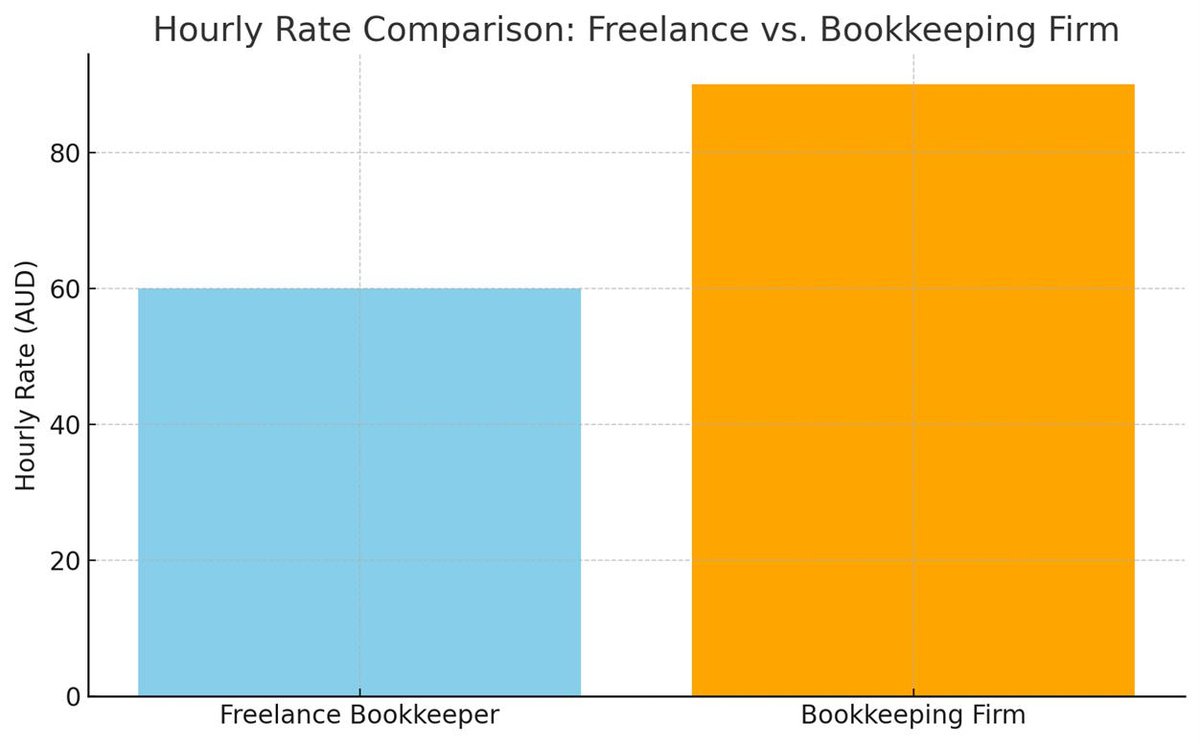
According to the Institute of Certified Bookkeepers (ICB Australia), the national benchmark rate for an experienced, registered contract bookkeeper is currently $97 to $104 per hour. This figure serves as the baseline for certified professionals managing comprehensive financial compliance across the country, and it’s the number I quote when clients ask whether a $60/hr quote from a “bookkeeper” they found on a generic listings site is realistic. It usually isn’t- at $60/hr you’re either paying an unregistered operator who can’t legally lodge your BAS, or a registered agent who isn’t covering their own PI insurance, software, and superannuation costs and will not be in business twelve months from now.
The national benchmark is shaped by three things: the bookkeeper’s professional qualification, the regulatory body they answer to, and what they are legally permitted to do for a fee. ICB Australia and the Australian Bookkeepers Association (ABA) maintain voluntary professional standards and continuing-education requirements; the Tax Practitioners Board (TPB) maintains the statutory register of BAS Agents authorised to charge for BAS services under section 50-5 of the Tax Agent Services Act 2009.
| Professional Qualification | National Hourly Benchmark (AUD) | Regulatory Status |
|---|---|---|
| Non-credentialed Data Entry | $40 – $60 | Unregulated |
| Certified Bookkeeper (ICB / ABA) | $70 – $90 | Industry Association Member |
| Registered BAS Agent | $97 – $120+ | Regulated by TPB |
The legitimate market floor for a Registered BAS Agent in Australia in 2026 sits at the ICB benchmark of $97/hr. Anyone charging materially below that is almost always carrying hidden risk- either to themselves (operating uninsured or undercutting their own compliance overhead) or to you (lodging your BAS without legal authorisation, which voids your statutory protection if the ATO opens a compliance review). Verify any agent on the TPB public register at tpb.gov.au/public-register before agreeing to a rate.
The Most Common Pricing Confusion- Employee Wage vs Service Rate
Most Australian bookkeeping cost guides quote bookkeeping rates of “$30 to $40 per hour” without explaining that figure refers to an employed bookkeeper’s wage, not what a contractor or BAS Agent charges as a service. The two are entirely different numbers.
According to PayScale Australia (2026), the average employed bookkeeper earns $31.75 per hour, with senior payroll bookkeepers reaching around $41.56. ERI SalaryExpert puts the 2026 average gross salary at $69,530, with senior bookkeepers at $77,752. Those numbers describe what your business pays a staff member on payroll– not what an external bookkeeper or BAS Agent charges to deliver bookkeeping as a service.
The service rate runs roughly double the wage rate, and there is a structural reason. When you engage external bookkeeping services, you’re not paying for their hourly time alone- you’re covering the 12% Superannuation Guarantee they pay themselves (up from 11.5% in mid-2025), public liability and professional indemnity insurance, software licences (Xero Partner, MYOB Partner, practice management tools, Hubdoc, Dext), continuing professional development hours to maintain TPB registration, business overheads, and statutory liability for the advice they sign off on. A BAS Agent charging $90/hr typically takes home $40–$50/hr after costs, comparable to a senior employed bookkeeper’s hourly wage.
This matters when comparing quotes. If a bookkeeper offers bookkeeping services at $35/hr, you are most likely dealing with an employee moonlighting off the books, an unregistered overseas operator white-labelling under an Australian shopfront, or someone not covering their own compliance costs- which means they will inevitably cut corners on yours. When comparing any bookkeeping cost in Australia quote, always ask whether the headline hourly rate represents an employee wage or a true service rate.
What’s Actually Included in a Bookkeeping Engagement?
Half the confusion around bookkeeping costs comes from not knowing what you’re meant to be paying for. Engagements are split into two categories: core compliance work that should be in any legitimate package, and value-added services that legitimately attract a premium.
Core Bookkeeping (Should Be in Every Package)
Data entry and transaction coding cover every sale, purchase, and bank movement coded to the correct account in your chart of accounts. Bank, credit card, and clearing account reconciliation handles Stripe, Square, PayPal, and EFTPOS clearing accounts that need to match the cash actually hitting your trading bank account. Accounts payable means entering supplier bills, scheduling payment runs, and managing supplier statements. Accounts receivable means issuing customer invoices, sending payment reminders, and applying receipts. GST coding requires correctly applying GST-free, GST-inclusive, input-taxed, and out-of-scope codes- the single most common audit risk for Australian small businesses. Payroll processing covers pay runs, PAYG withholding calculations, and Single Touch Payroll (STP) Phase 2 lodgements to the ATO. Superannuation handling means calculating and submitting super through a SuperStream-compliant clearing house quarterly or monthly. BAS preparation and lodgement (quarterly or monthly), signed off and lodged through the BAS Agent’s tax portal, is the compliance endpoint.
Value-Added Services (Legitimate Premium)
Financial reporting means monthly P&L, balance sheet, and cash flow statements with practitioner commentary- not just raw exports from Xero. Budgeting and forecasting build a 12-month rolling forecast and tracks variance against actuals. Software setup and migration covers moving from MYOB to Xero, configuring a new chart of accounts, and setting up bank rules and Hubdoc. Catch-up and rescue work cleans up months or years of unreconciled clearing accounts; this is almost always charged at hourly rescue rates because the scope is unpredictable until we open the file. Advisory work covers cash flow management, equipment finance reviews, pricing analysis, and GST registration timing decisions.
If your current bookkeeper is invoicing monthly but delivering only data entry and reconciliation, you are paying full-package prices for half a service. Ask for a written scope document- every legitimate BAS Agent in 2026 should produce one within 48 hours. Knowing exactly what your bookkeeping cost Australia covers is the only way to compare bookkeeping services quotes fairly.
Hourly vs Fixed Monthly vs Per-Transaction vs Subscription- Which Pricing Model Fits Your Business?
The way your bookkeeper structures their fees can severely impact your operational budget. In 2026, four bookkeeping cost Australia models compete in the Australian market — hourly billing, fixed monthly retainer, bookkeeping price per transaction, and subscription tiers- and the right one depends entirely on the predictability of your transaction volume.
| Pricing Model | Best For | Typical Market Rate (2026) | Risks & Downsides | When to Switch |
|---|---|---|---|---|
| Hourly Rate | Catch-up jobs, rescue work, unpredictable volumes, system migrations | $50 – $120/hr | Bill shock. Inefficient bookkeeping costs you more for the same outcome. No budget certainty. | Switch to fixed monthly once your transaction volume stabilises (usually after 3–6 months of clean trading). |
| Fixed Monthly Retainer | Established businesses needing budget certainty and recurring compliance | $300 – $1,500/mo | Paying for unused capacity if your business scales down. Scope creep is common- your retainer needs renegotiating as you grow. | Switch to hourly only if pausing trade or closing down. |
| Per-Transaction | High-volume ecommerce or hospitality with simple, repetitive sales data | $0.50 – $3.00 per line | Rare in 2026; difficult to price complex advisory work this way. Costs balloon as you grow. | Switch to fixed monthly once payroll and advisory needs grow. |
| Subscription / Fixed Tier (new in 2026) | Predictable small business needs with a defined scope | $249 – $1,500/mo | Standardised tiers- if your needs fall outside the scope, you upgrade or add on. Less bespoke. | Switch to a custom retainer when your operations outgrow the highest tier. |
As a practitioner, I’ll tell you why most established BAS Agents in 2026 prefer their bookkeeping cost Australia structure stable- prefer fixed-fee monthly packages over an hourly rate. Hourly billing penalises the bookkeeper for being efficient on bookkeeping cost work and investing in automation. If I use my Xero expertise to cut a four-hour manual reconciliation down to twenty minutes using bank rules, Hubdoc, and Dext, hourly billing means I lose revenue for being good at my job. Bookkeeping monthly packages align our goals: you get cost certainty and clean books, and the agent is rewarded for streamlining your systems rather than padding hours.
The subscription model is the genuine 2026 disruption. Providers like Advancr (entry from $249/month) and Scale Suite (embedded teams from $1,500/month) are publicly advertising no-lock-in tiered pricing, with the scope of every tier documented upfront. This is forcing traditional firms- including some long-established ones- to either publish their rate cards or lose price-conscious leads to the new entrants. If your needs are predictable and you don’t require bespoke advisory, the subscription model is often the cheapest legitimate option in the Australian market right now.
A practical decision framework:
- Fewer than 50 transactions/month, no payroll → hourly or micro subscription
- 50–300 transactions, stable, payroll for under 5 → fixed monthly or subscription tier
- 300+ transactions, payroll for 10+, complex compliance → bespoke fixed monthly retainer
- Catch-up, rescue work, system migration → hourly project rate
What Drives Your Bookkeeping Cost in Australia? (7 Real Drivers)
Transaction volume is the baseline metric every bookkeeper looks at before issuing a bookkeeping quote. It’s not just about the raw number of sales- it’s the number of individual movements through your bank feeds, credit cards, and clearing accounts (Stripe, Square, PayPal, Afterpay) that require coding, matching, and reconciliation. A café processing 500 tap-and-go payments daily through an integrated POS system might take less time than a consultancy issuing 20 highly complex, milestone-based invoices a month. As a rule of thumb, allow one bookkeeper hour per 80 reconciled transactions for a clean, well-rule’d Xero file; double that if your bank feeds are messy or your clearing accounts are unreconciled.
Payroll complexity adds significant overhead to your hourly or monthly bookkeeping cost. Processing a straightforward salary for two full-time staff is simple, but managing a fluctuating roster of casuals under complex modern awards (the Hospitality Industry General Award is the standard nightmare example) requires meticulous attention. Single Touch Payroll (STP) Phase 2 compliance, varied leave accruals, termination payouts, redundancy calculations, and Superannuation Guarantee clearing house batches all demand high-level expertise and increase the risk profile of the work. Allow approximately 0.4 hours per employee per month for standard salaried payroll, rising to 0.8+ hours per casual under award rates with shift penalties.
BAS frequency dictates how often your agent needs to perform a hard close on your accounts. If your business is registered for GST and turns over more than $20 million, the ATO requires monthly BAS lodgements- quarterly is the standard for everyone below that threshold. Once you have employees, you’ll likely need monthly Instalment Activity Statements (IAS) for PAYG withholding regardless. The more frequently we have to verify the data, generate the reports, and lodge through our tax agent portal, the higher your baseline bookkeeping cost Australia 2026.
Your software stack can either drastically reduce or inflate your bookkeeping costs in Australia. Businesses running on a clean integrated cloud stack- Xero with Dext for receipt capture, A2X for ecommerce, ServiceM8 for trades- generally cost less to manage because data flows seamlessly. Conversely, if you’re running legacy desktop software, heavily relying on spreadsheets, or using industry-specific CRMs that don’t talk to your accounting ledger, the manual extraction and manipulation of data drives fees straight up. Manual paper-receipt businesses typically pay 30–40% more than equivalent businesses on a fully automated stack.
The condition of your existing books is the primary reason bookkeepers charge upfront rescue or onboarding fees. If your previous bookkeeper miscoded assets as expenses, left years of unreconciled clearing accounts, or failed to match payroll clearing to the bank feed, a new agent cannot simply start lodging your BAS. We have to unravel the mess to protect our own TPB registration and ensure your ATO reporting is compliant- which requires intensive forensic work. Catch-up engagements typically run $500–$5,000 depending on the size of the backlog.
Industry compliance overhead varies wildly across the Australian landscape. A freelance graphic designer has minimal statutory requirements beyond standard GST and income tax. Compare this to a real estate agency requiring rigorous daily trust account reconciliations under state-based real estate legislation, an allied health clinic navigating NDIS claiming portals and complex GST-free vs GST-applicable service splits, or a construction firm managing TPAR (Taxable Payments Annual Report) lodgements and subcontractor compliance. The heavier the regulatory burden of your specific industry, the more you pay for an agent qualified to handle it.
Advisory scope is what turns a standard data-entry bookkeeper into a virtual financial controller. If you only want your bank reconciled and BAS lodged, you pay a baseline compliance fee. If you want cash flow forecasting, budget variance analysis, bespoke management reporting, and proactive advice on equipment finance or pricing strategy, you’re stepping into advisory territory. This requires a deeper understanding of your business operations and commands a premium hourly rate of $110–$150+/hr for the qualified specialists doing the work. Each of these seven drivers feeds directly into your final monthly bookkeeping cost.
Bookkeeping Software Costs in Australia (2026)
Your choice of accounting software directly impacts your monthly bookkeeping cost. Cleaner platforms reduce bookkeeper hours; legacy or fragmented systems inflate them. Here’s where the major Australian platforms sit in 2026.
| Software | Plan Examples | 2026 Monthly Cost (AUD)* | Typically Included in Bookkeeping Package? |
|---|---|---|---|
| Xero | Ignite / Grow / Comprehensive / Ultimate | $35 – $115/month | Often included by Xero Partner bookkeepers |
| MYOB | Lite / Pro / AccountRight | $32 – $145/month | Sometimes included |
| QuickBooks Online | Simple Start / Essentials / Plus / Advanced | $28 – $135/month | Usually optional |
| Reckon One | Accounting Plus / Payroll Premium | $29 – $99/month | Rarely included |
| Zoho Books | Free / Standard / Premium / Elite | $0 – $70/month | Often optional |
*Prices verified against publicly listed 2026 plans and rounded; subject to provider repricing.
A few practitioner notes that most bookkeeping cost Australia guides won’t tell you. Xero increased its plan structure in 2024 (Ignite/Grow/Comprehensive/Ultimate replacing the old Starter/Standard/Premium tiers), and most Australian small businesses now sit on Grow at around $80/month. MYOB’s AccountRight desktop product is being progressively phased toward the cloud-only Business platform- if you’re still on a desktop file, factor migration cost ($800–$2,500 depending on file age) into your 2026 budget. QuickBooks Online is gaining ground in Australia among freelancers and tradies but lags behind Xero on payroll compliance for complex awards. Zoho Books’ free tier is genuinely free for businesses under $50K turnover and is the cheapest legitimate compliant option for very early-stage sole traders.
Add-on apps that materially affect bookkeeper time include Hubdoc (free with most Xero plans), Dext Prepare ($25–$45/month), A2X for Shopify/Amazon sellers ($25–$200/month depending on order volume), and Employment Hero for HR-integrated payroll ($8–$15 per employee per month). A well-configured automation stack typically saves 3–6 bookkeeper hours per month- often the difference between the $400 and $700 small business package tier.
Always clarify upfront whether software licences are included in your bookkeeping cost or billed separately. Reputable BAS Agents on Xero Partner pricing pass the wholesale rate to the client (often 25–50% below retail), which is a legitimate value add the client should be told about. Software licences are part of your total bookkeeping cost even when invoiced separately, so always ask for the all-in figure.
Bookkeeping Cost by State- Metro vs Regional in 2026
While cloud accounting means I can service a client in Perth from my desk in Melbourne, geographic location still influences prevailing market rates. Metro bookkeeping rates run consistently higher than regional bookkeeping rates because of higher commercial rent, higher staff wage expectations driven by ABS Average Weekly Earnings data, state-based payroll tax that bookkeeping firms scaling their own operations have to pay, and the higher density of specialised BAS Agents in metropolitan areas.
| State / Territory | Metro Hourly Rate | Regional Hourly Rate | Typical Small Business Monthly Package |
|---|---|---|---|
| New South Wales (NSW) | $80 – $130/hr | $65 – $100/hr | $500 – $1,200 |
| Victoria (VIC) | $75 – $120/hr | $60 – $95/hr | $450 – $1,100 |
| Queensland (QLD) | $70 – $110/hr | $60 – $90/hr | $400 – $1,000 |
| Western Australia (WA) | $75 – $115/hr | $65 – $95/hr | $450 – $1,100 |
| South Australia (SA) | $65 – $100/hr | $55 – $85/hr | $350 – $900 |
| Tasmania (TAS) | $65 – $95/hr | $55 – $80/hr | $350 – $850 |
| Australian Capital Territory (ACT) | $80 – $125/hr | N/A | $500 – $1,100 |
| Northern Territory (NT) | $75 – $115/hr | $65 – $90/hr | $450 – $1,000 |
Rates sourced from ICB Australia member fee benchmarks, Seek and Indeed Australia bookkeeping listings (April 2026), and TPB-registered agent fee data. Confirmed against advertised rates on Arbour Advisory, Scale Suite, Advancr, and Morelli Bookkeeping.
State-based payroll tax is a real but rarely discussed bookkeeping cost driver of bookkeeping cost differences. Bookkeeping firms scaling their own operations factor in varying thresholds when pricing client work- Victoria’s payroll tax kicks in at $900,000 of annual wages, NSW at $1.2 million, Queensland at $1.3 million. Firms operating in higher-tax states either pass that cost through to clients or absorb it from margin. Regional bookkeepers often have lower overheads (lower commercial rent, no payroll tax exposure at smaller scale, lower staff wage expectations), which lets them offer more competitive rates- though the widespread adoption of remote work since 2020 is slowly flattening the metro/regional gap. By 2026, a regional Tasmanian BAS Agent serving Melbourne clients remotely is increasingly common, and is often 15–25% cheaper than a metro-Melbourne firm doing identical work.
State-by-state bookkeeping cost Australia variation is narrowing as cloud accounting removes geography as a billing factor. Sydney sits at the top of the Australian rate spectrum for the same reasons it sits at the top of every professional services rate spectrum- commercial rent, talent competition, and concentration of complex industry clients (legal, finance, construction, hospitality). Melbourne runs roughly 5–10% below Sydney on average. Brisbane, Perth, and Adelaide cluster in the middle. Hobart and Darwin sit at the lower end of the metro range. If you’re running a remote-friendly business, there’s no operational reason your bookkeeper has to be in your city- and a Hobart-based BAS Agent serving you from Tasmania often delivers the same quality work for noticeably less than a CBD Sydney firm.
What Is the Hourly Rate for Bookkeepers in Melbourne?
The standard hourly rate for professional bookkeepers in Melbourne ranges from $75 to $130 per hour in 2026, heavily influenced by their legal qualifications and specific operating location. Rates fluctuate across the city, with inner-city specialists often commanding different fees than suburban generalists. As a Registered BAS Agent based in Melbourne, I see this spread play out every quarter when clients share competing quotes during their BAS review meetings.
Three forces drive the Melbourne rate spread: the cost of operating in inner-city locations (commercial rent, parking, professional indemnity premiums weighted by claims history), the concentration of complex industries in specific suburbs (creative studios in Fitzroy and Richmond, allied health and professional services in South Yarra and the CBD), and the depth of certified, registered competition in each catchment. A solo BAS Agent working remotely from Werribee with a low overhead base can sustainably charge $70/hr; the same agent operating from a Collins Street office cannot.
| Melbourne Location & Tier | Typical Rate (AUD, ex GST) | Typical Client Profile |
|---|---|---|
| Outer Suburbs / Remote Only | $60 – $80 | Sole traders, micro-businesses |
| Inner North (Fitzroy, Richmond) | $85 – $110 | Creative studios, cafés, hospitality |
| CBD & South Yarra | $95 – $130+ | Allied health clinics, professional services |
The “remote only” tier refers to BAS Agents who operate fully online with no physical client meetings- most are based in outer suburbs or regional Victoria and pass the lower overhead through to clients. They’re a legitimate option for businesses on a fully cloud-based stack (Xero, Hubdoc, Dext) that don’t need in-person reviews. The trade-off is reduced face-time and slower onboarding when complex catch-up work is required.
If you’re getting Melbourne quotes that fall outside these ranges, ask why. Above $130/hr should buy specialised work (NDIS claiming portals, trust accounting, system migration, multi-entity structures); below $60/hr almost always indicates an unregistered operator or offshore work being white-labelled under a Melbourne shopfront- both of which void your statutory protection if your BAS lodgement triggers an ATO compliance review.
Bookkeeping Cost by Business Type
Different industries require completely different bookkeeping cost workflows. Here’s a baseline look at how your industry impacts your monthly bookkeeping cost in 2026.
| Business Type | Estimated Monthly Cost | Key Cost Drivers |
|---|---|---|
| Sole Trader / Freelancer | $150 – $300 | Minimal transactions, simple GST (if registered), no payroll, quarterly BAS only. |
| Tradie / Contractor | $300 – $700 | TPAR (Taxable Payments Annual Report) compliance, heavy receipt management, vehicle and tool tracking, job costing for fixed-price work. |
| Allied Health / NDIS | $500 – $1,200 | GST complexities (mixed taxable / GST-free supplies), practice management software integration (Cliniko, Halaxy, Power Diary), NDIS participant-level reporting. |
| Cafés / Hospitality | $600 – $1,500+ | Complex award payroll, heavy casual rosters with shift penalties, daily POS clearing reconciliations, supplier invoice volume, tip handling. |
| Ecommerce (Shopify / WooCommerce) | $500 – $1,500+ | High transaction volume, inventory management, merchant fee reconciliations across multiple gateways, multi-currency settlements, A2X integration. |
| Creative Studios / Agencies | $400 – $1,000 | Project-based invoicing, retainer billing, contractor payments, royalties and IP licensing splits. |
| Real Estate / Legal | $800 – $2,000+ | Strict trust account compliance (state-based legislation), high-stakes auditing requirements, daily reconciliations. |
| Construction | $700 – $1,800 | Job costing, retentions, subcontractor management, TPAR lodgement, complex GST timing on progress claims. |
These bookkeeping cost ranges are baselines for businesses with reasonably clean books on a modern cloud stack. Add 30–50% for the first three months of any engagement if your existing books need cleanup, and add 15–25% for businesses operating across multiple entities (e.g. trading trust + bucket company + family trust). Industry context shapes your bookkeeping cost Australia more than business size alone in 2026.
Bookkeeping Cost Calculator Australia: Estimate Your 2026 Monthly Fee
While Lyvia’s bookkeeping services are quoted per scope (request a discovery call for an exact figure), you can estimate your own baseline requirements using a standard industry framework. This is the same formula I use during initial scoping calls before producing a written quote.
The Estimation Formula:
Estimated monthly hours = (Transactions ÷ 80) + (Employees × 0.4) + BAS frequency factor + Advisory hours
Estimated monthly bookkeeping cost = Estimated hours × prevailing BAS Agent hourly rate in your state
Where:
- Transactions = total reconciled bank, credit card, and clearing account movements per month
- Employees = headcount on payroll (use 0.6 instead of 0.4 for casual-heavy hospitality awards)
- BAS frequency factor = 1 for quarterly lodgement, 2 for monthly
- Advisory hours = 0 for compliance-only, 2–6 for active forecasting/budgeting work
Worked Example 1: Sole Trader Graphic Designer (Melbourne)
A sole-trading graphic designer with 50 monthly transactions, no employees, quarterly BAS, no advisory.
- Transactions: 50 ÷ 80 = 0.6 hours
- Employees: 0 × 0.4 = 0 hours
- BAS: Quarterly (factor 1) = 1 hour spread monthly
- Advisory: 0 hours
- Total estimated hours: 1.6 per month
- Estimated cost: 1.6 hours × $90/hr (VIC metro BAS Agent hourly rate) = $144/month
This designer is better served by a low-tier subscription package ($199–$249/month) than by hourly billing, because the fixed-fee includes BAS lodgement, software, and email support that hourly contracts usually exclude.
Worked Example 2: Melbourne Café (4 Casual Staff)
A Melbourne café with 400 monthly transactions, 4 casual staff on the Hospitality Industry General Award, quarterly BAS, no advisory.
- Transactions: 400 ÷ 80 = 5 hours
- Employees: 4 × 0.6 (casuals on award) = 2.4 hours
- BAS: Quarterly (factor 1) = 1 hour spread monthly
- Advisory: 0 hours
- Total estimated hours: 8.4 per month
- Estimated cost: 8.4 hours × $95/hr = $798/month
This sits at the top of the small business package range, which is consistent with hospitality being one of the more expensive industries to bookkeep in Australia. If the café also wants weekly cash flow reporting and quarterly P&L review meetings, add 2 advisory hours ($190)- total approximately $988/month.
Worked Example 3: Shopify Ecommerce Store (8 Staff, Sydney)
A Sydney-based Shopify store with 600 monthly transactions across Shopify Payments and Stripe, fortnightly payroll for 8 staff, quarterly BAS, monthly inventory reconciliation.
- Transactions: 600 ÷ 80 = 7.5 hours
- Employees: 8 × 0.4 = 3.2 hours
- BAS: Quarterly (factor 1) = 1 hour spread monthly
- Advisory: 2 hours (inventory and margin reporting)
- Total estimated hours: 13.7 per month
- Estimated cost: 13.7 hours × $105/hr (NSW metro BAS Agent hourly rate) = $1,439/month
This bookkeeping cost estimate matches what reputable Sydney ecommerce-specialist firms quote for an equivalent business. If the store integrates A2X (recommended for any Shopify or Amazon seller above $200K turnover), the inventory reconciliation hours typically drop by half- bringing the monthly bookkeeping cost closer to $1,200. Use this calculator as a sanity check before you accept any bookkeeping cost quote- a quote that diverges by more than 30% from the formula deserves a written explanation.
Payroll, BAS, and STP- Add-On Costs Explained
Most bookkeeping packages treat payroll and BAS lodgement as variable add-ons because no two businesses look the same. Understanding what each one legitimately costs in 2026 protects you from being either overcharged or- more dangerously- undercharged by an unregistered operator who will eventually expose you to ATO penalties.
Payroll Processing
A standard payroll bookkeeping cost per employee in Australia typically runs $10 to $25 per payslip in 2026. This fee covers wage calculation, leave accrual, payslip generation, and crucially, Single Touch Payroll (STP) Phase 2 reporting to the ATO at the close of every pay run. STP Phase 2, mandatory under legislation from 1 January 2022 with phased rollout completed across 2022–2023, requires significantly more granular reporting than Phase 1 — including disaggregation of gross income types (overtime, bonuses, allowances, paid leave) and country codes for foreign workers. Done properly, Phase 2 takes longer per pay run than Phase 1; if your bookkeeper hasn’t increased their payroll fee since 2022, they’re likely either skipping required disaggregation or absorbing the cost.
Superannuation processing typically adds $30–$100/month or is bundled into the per-payslip fee. Under the 2025–26 Superannuation Guarantee rate of 12% (up from 11.5% on 1 July 2025), super processing is now a meaningful compliance line item. From 1 July 2026, the proposed Payday Super reform- which requires employers to pay super at the same time as wages, not quarterly- will materially increase payroll administration time. Expect payroll fees to rise 10–15% in the second half of 2026 if Payday Super is enacted as drafted.
BAS Lodgement Cost
A standalone BAS lodgement costs $100 to $300 per quarter in Australia in 2026, assuming your accounting software is already reconciled and ready for lodgement. Monthly BAS lodgement (mandatory for businesses with turnover above $20 million) costs $150–$400 per month. If your BAS Agent has to clean up unreconciled accounts before lodgement, hourly rescue rates apply on top.
There is a critical legal reality here that most online bookkeeping cost guides quietly omit: under section 50-5 of the Tax Agent Services Act 2009 (TASA), it is an offence for anyone other than a Registered BAS Agent or Registered Tax Agent to charge a fee for providing BAS services. This includes preparing your BAS, advising on GST, advising on PAYG withholding, advising on superannuation guarantee obligations, and lodging with the ATO. The civil penalty for unregistered operators is up to 250 penalty units per offence under TASA 2009. If a cheap bookkeeper offers to lodge your BAS or advise you on GST and they are not on the TPB public register, they are breaking the law- and you have no statutory protection if their error triggers an ATO audit.
You can verify any agent’s registration in 30 seconds at tpb.gov.au/public-register. If they cannot give you their BAS Agent number, walk away.
STP Compliance
STP Phase 2 lodgement is required for every Australian employer regardless of size. Most BAS Agents include STP within their payroll fee; standalone STP-only services typically cost around $50/month. There is no legitimate scenario in 2026 where an Australian employer is exempt from STP- if your current bookkeeper isn’t lodging STP after every pay run, you have a serious compliance problem.
Professional Indemnity Insurance- TPB Minimum Cover
The TPB requires every registered BAS Agent to hold professional indemnity (PI) insurance meeting minimum standards under TPB(EP) 03/2010. For agents with annual turnover under $75,000, the minimum cover is $250,000. For agents with turnover above $500,000, the minimum cover is $1 million aggregate, inclusive of legal and defence costs. Cover scales between these bands and must be provided by an APRA-approved insurer. This is a real cost (typically $800–$2,500/year for a solo BAS Agent) that legitimate operators carry. These payroll, BAS, and STP add-ons typically represent the largest variable line in your monthly bookkeeping cost.
In-House vs Freelance BAS Agent vs Bookkeeping Firm- True Cost Comparison
When Australian businesses hit a growth ceiling, they often wonder whether to hire an in-house bookkeeper. The answer almost always comes down to volume of work- and the loaded cost of an in-house hire is consistently underestimated.
The True Loaded Cost of an In-House Bookkeeper (2026)
If you hire a mid-level internal bookkeeper at a salary of $70,000 for a 38-hour week, your costs do not stop at the salary. Add:
- Superannuation Guarantee at 12% (effective 1 July 2025): $8,400
- Annual leave accrual (4 weeks): ~$5,400 in coverage
- Personal/carer’s leave (10 days): ~$2,700
- Workers compensation insurance (varies by state, ~1–3% of wages): $700–$2,100
- Payroll tax (if your total wages cross your state threshold): variable
- Recruitment and onboarding: $3,000–$8,000 one-off
- Workstation, monitors, software seat licences (Xero, MYOB, Office 365): $2,500–$4,500/year
- Continuing professional development: $1,000–$2,500/year
The true loaded cost of a $70,000 in-house bookkeeper exceeds $87,000–$92,000 per year when fully accounted for- and that’s before factoring downtime during leave, sick days, or staff turnover.
Freelance BAS Agent or Bookkeeping Firm
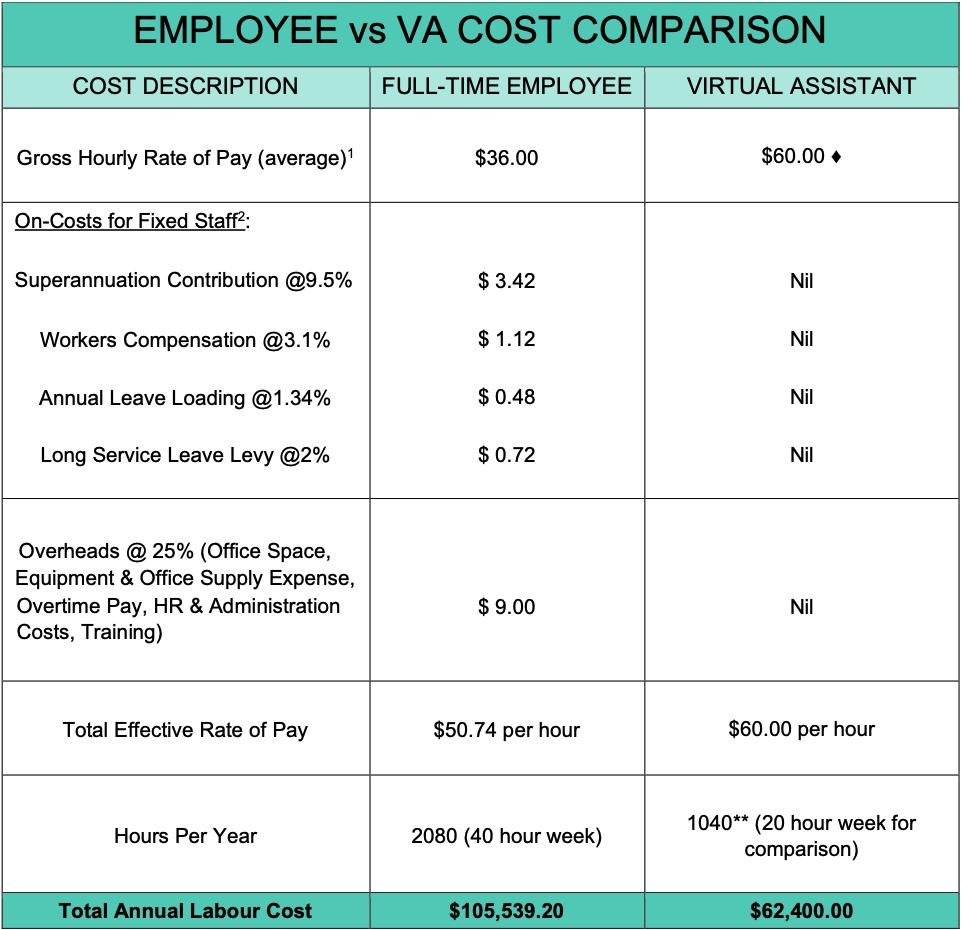
A premium freelance BAS Agent or boutique bookkeeping firm typically charges $1,000–$1,800/month for an established small-to-medium business- call it $15,000–$22,000 per year. You are getting senior-level expertise, strict TPB compliance, professional indemnity coverage, software stack management, and absolute flexibility- without HR overhead, leave liabilities, recruitment risk, or training cost.
| Engagement Type | Annual Cost (2026) | Best For | Hidden Costs |
|---|---|---|---|
| In-House Bookkeeper | $85,000 – $95,000 (loaded) | 30+ hours of dedicated bookkeeping work per week, multi-entity operations | Recruitment, leave coverage, software, training, turnover risk |
| Freelance BAS Agent (solo) | $12,000 – $25,000 | Small to medium businesses, predictable scope | Continuity risk if agent becomes unavailable |
| Boutique Bookkeeping Firm | $15,000 – $30,000 | Growing businesses needing redundancy + advisory | Slightly higher cost, possibly less personal attention |
| Subscription Bookkeeping | $3,000 – $18,000 | Predictable scope, tech-confident owners | Standardised tiers, less customisation |
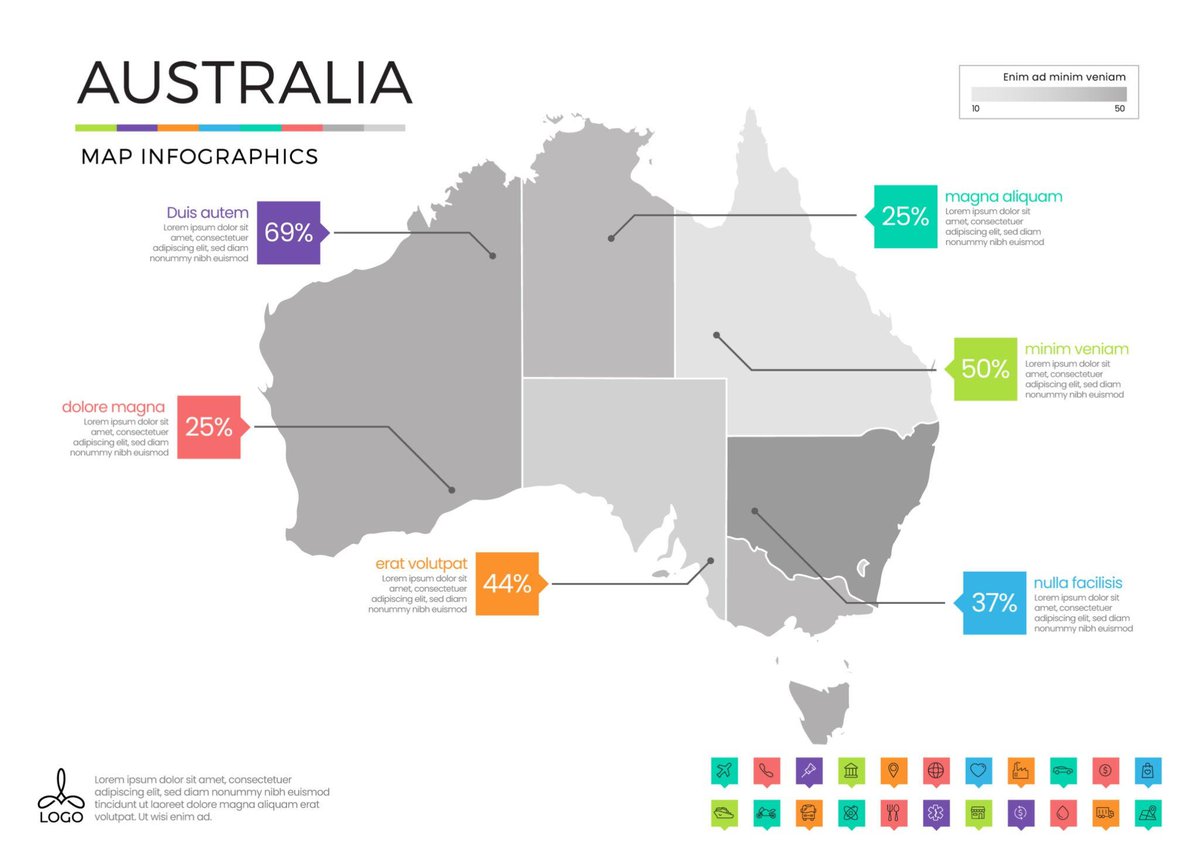
Decision Rule: Unless your business genuinely requires more than 30 hours of dedicated bookkeeping work per week, outsourcing wins on cost, compliance, and continuity. Most small and medium Australian businesses sit comfortably below that threshold and are paying 4–6x the necessary cost by hiring in-house out of habit or perceived control benefits.
Hybrid Models
Many growing businesses settle on a hybrid bookkeeping services model: an internal admin or office manager handles invoice entry and supplier bills (low-skill, high-volume tasks), while an external BAS Agent owns reconciliation, payroll, BAS, compliance, and reporting (high-skill, regulated tasks). This often delivers the lowest total cost while maintaining tight internal control over day-to-day financial operations. The line between “internal admin work” and “regulated bookkeeping work” should be drawn at anything that touches BAS, GST, PAYG, or super- those tasks must sit with a registered agent regardless of who does the upstream data entry. For most Australian SMBs, outsourced bookkeeping cost is materially lower than the loaded cost of an in-house hire when fully accounted for.
Are Bookkeeping Fees Tax Deductible in Australia?
Yes- bookkeeping fees are entirely tax deductible for Australian businesses. Under section 8-1 of the Income Tax Assessment Act 1997 (ITAA 1997)- the general deduction provision- costs incurred in producing assessable income or necessarily incurred in carrying on your business are fully deductible, provided they are not capital, private, or domestic in nature. Bookkeeping fits squarely within this provision.
The ATO further allows deductions specifically for managing your tax affairs under section 25-5 ITAA 1997, which covers fees paid to a recognised tax adviser (including registered BAS Agents and Tax Agents) for advice and services relating to your tax obligations. Taxation Ruling TR 95/25 provides additional guidance on deductibility of professional fees for tax-related work.
In practical terms, the following are all fully deductible business expenses:
- Monthly bookkeeping retainer fees
- Hourly bookkeeping cost Australia charges
- BAS lodgement fees paid to a registered BAS Agent
- Payroll processing and STP lodgement services
- Financial reporting (P&L, balance sheet, cash flow)
- Cloud accounting software subscriptions (Xero, MYOB, QuickBooks, Reckon, Zoho)
- Receipt capture apps (Hubdoc, Dext, AutoEntry)
- Software setup, migration, and training fees
- Bookkeeping advisory and budgeting work
- Catch-up or rescue work to bring your books current
You must retain invoices and engagement letters to substantiate your claim- the ATO can request supporting documentation up to five years after lodgement under standard record-keeping requirements. GST registered businesses can also claim the GST input tax credit on bookkeeping costs, effectively reducing your net bookkeeping cost by 10%.
If you’re unsure whether a specific bookkeeping-related expense is deductible in your circumstances, ask your registered tax agent- not your bookkeeper. Tax advice on deductibility specifically falls outside what a BAS Agent is registered to provide; it sits with Tax Agents under TASA 2009. Practically every line of your bookkeeping cost is deductible, which lowers the after-tax burden of working with a Registered BAS Agent.
Cash vs Accrual Bookkeeping- Which Applies to Your Business?
The accounting method you use determines when income and expenses are recorded- and there’s a specific ATO turnover threshold most cost guides leave out entirely.
Cash Basis Accounting
Income is recorded when payment is received; expenses are recorded when payment is made. Cash basis matches your bank statement closely and is the simplest method. It’s best suited to service-based small businesses where invoicing is prompt and most customers pay quickly. Cash basis tells you exactly how much money is in the bank but doesn’t reflect outstanding invoices owed to you or bills you owe to suppliers.
Accrual Basis Accounting
Income is recorded when it’s earned (when you raise the invoice); expenses are recorded when they’re incurred (when you receive the bill), regardless of when the cash actually moves. Accrual basis gives a far more accurate view of profitability and is required for any serious financial analysis. It also makes year-end tax planning more meaningful because you can see liabilities and receivables clearly.
The Critical $10 Million ATO Threshold
Here is the fact most Australian cost guides miss: under ATO rules, businesses with aggregated turnover below $10 million can elect to account for GST on a cash basis using Simpler BAS reporting. Once your aggregated turnover exceeds $10 million, the ATO requires you to report GST on a non-cash (accrual) basis. The threshold sits in section 29-40 of the GST Act 1999 and is reviewed periodically by Treasury.
For income tax purposes, the rules are slightly different. Most small businesses with turnover under $10 million also qualify as Small Business Entities (SBEs) under Division 328 of ITAA 1997 and can elect cash basis for income tax. Above $10 million, accrual basis is generally required.
Practically, this means a business approaching the $10 million turnover threshold needs to plan ahead. Switching from cash to accrual basis mid-year creates significant bookkeeping work and affects the timing of GST liabilities. If you’re growing fast and projecting to cross $10 million within 18 months, your bookkeeper should already be running parallel accrual reporting so the transition is mechanical rather than disruptive.
The Four Foundational Bookkeeping Types
Beyond cash vs accrual, you’ll encounter four foundational bookkeeping methods:
| Method | Best For | How It Works |
|---|---|---|
| Single-Entry | Very small sole traders, freelancers with minimal volume | Records each transaction once, like a simple register or checkbook. |
| Double-Entry | All serious businesses (the standard for compliant bookkeeping in 2026) | Every transaction posts an equal debit and credit. The accounting equation always balances. Required for businesses on cloud platforms like Xero. |
| Cash Basis | Service businesses below $10M turnover; tracks real cash position | Records income and expenses only when money changes hands. |
| Accrual Basis | Businesses above $10M turnover, inventory-holding businesses, anyone requiring true profitability analysis | Records income when invoiced, expenses when billed- regardless of payment timing. |
In practice, virtually every Australian business in 2026 operates on double-entry bookkeeping (because that’s how Xero, MYOB, and QuickBooks structure their general ledgers internally), and then makes a separate election about whether to report GST and income tax on a cash or accrual basis. The two questions are independent- your bookkeeping method is double-entry, and your reporting method is cash or accrual. Switching reporting methods can shift your bookkeeping cost up or down by 10–15% in the transition quarter as historical entries are recoded.
How to Reduce Your Bookkeeping Costs Without Cutting Corners
Lowering your bookkeeping cost Australia isn’t about finding the cheapest provider- it’s about reducing the number of hours your bookkeeper has to spend untangling preventable mess. Here’s what I tell every new client during onboarding.
Separate business and personal accounts completely. This single change reduces bookkeeping hours by 20–30% in most engagements. Mixed transactions (the gym membership paid from the business card, the supplier bill paid from your personal account) require investigation, journal entries, and Director’s Loan Account adjustments- all billable bookkeeper time. Open a dedicated business transaction account and a separate business credit card, and never cross them.
Capture receipts at the point of purchase, not at month-end. Use Hubdoc (free with most Xero plans) or Dext Prepare (~$30/month) to photograph receipts the moment you receive them. The app extracts supplier name, amount, GST, and date automatically and feeds the data into your accounting ledger. This eliminates the end-of-month receipt hunt and the inevitable lost-receipt write-offs that cost you legitimate GST input credits.
Reconcile weekly, not quarterly. Weekly reconciliation takes 15–30 minutes. Quarterly reconciliation often takes 8–12 hours because the bookkeeper has to reconstruct context that’s three months old. The catch-up rate also runs higher than the regular rate, so quarterly catch-up is genuinely 3–5x the cost of weekly maintenance.
Engage a Registered BAS Agent for your bookkeeping services rather than an unregistered bookkeeper. This sounds counter-intuitive because BAS Agents charge more per hour. But unregistered bookkeepers can’t legally sign off on BAS, can’t advise on GST coding, and can’t represent you to the ATO- so you end up paying twice (once for the bookkeeper, once for an accountant to fix and lodge). The total cost of working with a registered agent is almost always lower than the apparent saving from an unregistered one.
Keep your chart of accounts tight. A bloated chart of accounts with 200+ active codes makes coding decisions slower and creates inconsistency across pay periods. Most small businesses operate cleanly on 40–80 active accounts. Have your BAS Agent do a chart-of-accounts review annually and archive anything unused.
Use bank rules ruthlessly. A well-configured Xero file with 30–50 bank rules in place can auto-code 60–80% of recurring transactions before a human ever opens the file. Setting these up takes a few hours of your bookkeeper’s time once and saves dozens of hours per year on an ongoing basis.
Don’t outsource overseas to save bookkeeping cost. I’ll cover this in detail under red flags, but the short version: offshore bookkeeping shops working under Australian shopfront brands often produce work that needs to be redone locally before BAS lodgement, and they introduce Privacy Act 1988 (APP 8) compliance issues if your client data is sent overseas without explicit consent. The apparent saving evaporates within 90 days. Each of these levers shaves measurable hours- and therefore real bookkeeping cost- off your monthly invoice.
Red Flags When Choosing a Bookkeeper
Not all practitioners are created equal, and the bookkeeping cost of choosing badly is much higher than the price of choosing carefully. Watch for these four severe red flags.
Red flag 1: Quoting BAS lodgement without TPB registration. As covered under TASA 2009, charging a fee for BAS services without registration is an offence carrying civil penalties up to 250 penalty units per breach. Always ask for the BAS Agent number and verify it on the public register at tpb.gov.au/public-register. The register also shows any conditions, suspensions, or sanctions on the agent’s registration. If they refuse to provide a number- or claim “I work under my accountant’s licence” without producing the accountant’s tax agent number- they are not registered.
Red flag 2: Offshore data handling without explicit consent. Under the Privacy Act 1988 and Australian Privacy Principle (APP) 8, an Australian agent must take reasonable steps to ensure overseas recipients of personal information do not breach Australian privacy law, and must inform you that your data is being sent overseas. Many “Australian” bookkeeping shops are quietly outsourcing to data-processing teams in the Philippines or India. Some do this transparently and compliantly, with explicit consent and proper data handling- that’s fine. Many don’t. If your bookkeeper can’t tell you exactly where your financial data is stored and processed, walk away.
Red flag 3: No Professional Indemnity insurance. TPB-registered BAS Agents are required to carry minimum PI cover ($250,000 per claim and $1 million aggregate for agents earning under $75,000 fee income, scaling upward above that). PI insurance protects you if the bookkeeper makes a catastrophic error- incorrect GST coding triggering an ATO audit, missed payroll obligations, or filing errors that result in penalty interest. Ask to see a current certificate of currency. If they hesitate, they probably don’t have it.
Red flag 4: Headline bookkeeping rates below $35/hour for “professional bookkeeping.” Below $35/hr in 2026, the math simply doesn’t work for a legitimate Australian-based registered BAS Agent. Once you back out 12% super, PI insurance, software licences, business registration, ASIC fees, professional development hours required to maintain TPB registration, and basic business overhead, anyone charging below $35/hr is either an unregistered operator, an offshore white-label, or someone heading toward financial collapse who will leave you stranded mid-quarter. Price-shopping bookkeepers below this floor is a false economy.
Red flag 5 (bonus): Vague or refused written scope. Every legitimate engagement should produce a written engagement letter or scope document within 48 hours of agreement, signed by both parties. The scope should specify transactions covered, payroll headcount, software included, BAS frequency, and what triggers an out-of-scope variation. If your bookkeeper resists putting the engagement in writing, you have no recourse when scope creeps or quality drops. A low headline bookkeeping cost can hide compliance risk that costs you many multiples more later.
How to Get a Bookkeeping Quote (and What It Should Include)
A legitimate bookkeeping quote in Australia should arrive in writing within 48 hours of a discovery call and itemise five things: the BAS Agent’s TPB registration number, the software stack covered, the monthly transaction and payroll headcount limits, BAS frequency, and what triggers an out-of-scope variation. Verbal quotes and “starting from” figures with no scope attached are red flags — they leave you exposed to scope creep and you with no recourse if quality drops mid-engagement. Most reputable agents quote a fixed-fee monthly package once they’ve reviewed your file in Xero or MYOB, and offer an hourly rate only for catch-up or rescue work where scope can’t be predicted in advance.
7 Questions to Ask Before Hiring a Bookkeeper
Use this list before signing any engagement letter in 2026:
- What is your BAS Agent registration number? Verify it on tpb.gov.au/public-register. If they’re not registered, confirm whether a registered agent is supervising the work and lodging on their behalf.
- Where is my data physically stored, and who has access to it? The answer should be specific- “Xero servers in Sydney, accessed only by me from a secured Melbourne workstation” is good. “Our team handles it” is not.
- What’s the current PI insurance cover, and can I see a certificate of currency? Reputable agents send the certificate by return email within an hour.
- What’s included in your monthly fee, and what triggers an out-of-scope variation? You want a written scope document, not a verbal promise.
- How often do you reconcile, and how often will I receive financial reports? Weekly reconciliation is the modern standard; monthly reporting is the minimum for any serious engagement.
- What software are you certified in, and what’s your typical stack? Xero Certified Advisor, MYOB Partner, QuickBooks ProAdvisor- verifiable certifications matter more than self-claimed expertise.
- What happens if you go on leave or become unavailable? Solo BAS Agents should have a documented continuity arrangement (a peer agent on standby, a transition-of-records protocol). Firms should explain their team coverage. Either is fine; absence of an answer is not.
Two bonus questions for industry-specific bookkeeping services work: ask for the names of two current clients in your industry that the agent will let you contact, and ask what specific compliance challenges they’ve solved for those clients in the last 12 months. Vague answers here mean the industry experience is shallower than advertised. Walk through these questions before committing to any bookkeeping cost arrangement- the answers separate professional bookkeeping services from data-entry providers.
Bookkeeping Trends Affecting Pricing in 2026
Three trends are actively reshaping bookkeeping costs in Australia this year. Understanding them tells you whether your current quote is fair, future-proof, or already out of date.
Trend 1: AI-assisted bookkeeping is real, but it’s not lowering rates.
Cloud platforms now bundle machine-learning features that auto-categorise transactions, suggest bank rule matches, flag anomalies, and pre-fill BAS workpapers. Xero’s smart reconciliation, MYOB’s AI bill capture, and QuickBooks’ transaction prediction all materially reduce manual coding time. The reasonable expectation was that this would push bookkeeping rates and overall bookkeeping cost down. It hasn’t.
What’s actually happened is that AI tooling has shifted the value mix. The data-entry layer of bookkeeping is genuinely cheaper to deliver- but the interpretation, advisory, and compliance review layer is now a larger share of every engagement. BAS Agents who invested in AI tooling are charging the same $90–$110/hr they did in 2024, but they’re delivering deeper analysis in the same hours. Junior data-entry-only bookkeepers are being squeezed and many are leaving the profession; senior registered agents are commanding higher bookkeeping rates than ever. If your current bookkeeper hasn’t talked to you about how they’re using AI in your file, ask- it’s now a legitimate quality signal.
Trend 2: Payday Super becomes law on 1 July 2026, pushing payroll fees up 10–15%
The Treasury Laws Amendment (Payday Superannuation) Act 2025 received Royal Assent in November 2025, with the new regime commencing 1 July 2026. From that date, employers must pay Superannuation Guarantee contributions within 7 business days of each pay event- replacing the existing quarterly payment cycle. Late payment triggers an SGC liability with a 60% shortfall penalty plus daily interest, and the existing late-payment offset arrangement is removed entirely from 1 July 2026.
The ATO’s Small Business Superannuation Clearing House (SBSCH) also closes on 1 July 2026- small employers who relied on it will need to migrate to a commercial clearing house or their payroll software’s built-in solution before that date.
Payday Super materially increases payroll administration time. Every pay run becomes a super event, with corresponding clearing house batches, SuperStream 3.0 reporting, and ATO data matching. The ATO has issued Practical Compliance Guideline PCG 2025/D5 outlining a risk-based compliance approach for the first 12 months. Expect well-managed transitions to add $50–$200/month to existing payroll fees depending on headcount; expect poorly-managed transitions to result in SGC penalties.
If your bookkeeper hasn’t already started repricing conversations and system testing, raise it now- the lead time before 1 July is the safe window.
Trend 3: Subscription pricing is forcing the industry to publish rate cards.
The subscription disruption I covered earlier in this article (Advancr from $249/month, Scale Suite from $1,500/month, several others entering the market) is doing something the industry hasn’t seen before- making bookkeeping pricing genuinely transparent and comparable. Traditional firms that historically required a phone call before quoting are losing price-conscious leads to subscription providers who publish their tiers on a public pricing page.
The legitimate counter-argument from traditional firms is that bookkeeping is genuinely bespoke and tier-based pricing forces businesses into ill-fitting boxes. That’s true for some clients- particularly multi-entity, complex-industry, or advisory-heavy engagements. But for the majority of small Australian businesses with predictable transaction volumes and standard payroll, subscription is now the cheapest legitimate option in the market and is reshaping client expectations across the board.
If you’re still being quoted bespoke retainers for a vanilla 5-employee small business with quarterly BAS, you’re paying for the firm’s pricing-opacity advantage rather than for service quality. AI, Payday Super, and subscription pricing will all reshape your bookkeeping cost over the next 12 months- and your provider should be repricing transparently as each lands.
Final Thoughts- What Should You Actually Pay in 2026?
Here’s the practitioner summary. A fair range for legitimate Australian bookkeeping in 2026, delivered by a TPB-registered agent on modern cloud software, looks like this:
Hourly rates: $50–$120/hr for professional engagements. Below a $50/hr bookkeeping hourly rate, you’re paying for unregistered data entry. Above a $120/hr hourly rate, you’re paying for advisory or specialised compliance- verify it matches the work you actually need.
Bookkeeping fixed fees and monthly packages: $300–$1,500/month for 90% of small Australian businesses. Sole traders and simple sole-employee operations can sit in the $150–$300 range; complex businesses with multi-entity structures, heavy payroll, or specialised industry compliance run $1,500–$3,000+.
Subscription tiers: $249–$1,500/month for businesses with predictable, well-defined scope and tech-friendly operations. This is the cheapest legitimate option for most early-stage and stable small businesses in 2026.
The right bookkeeping cost for your business depends on transaction volume, payroll complexity, BAS frequency, software stack, and whether your books are clean or need rescue. Use the formula in this article to estimate your own baseline before requesting quotes- it will tell you immediately whether a quote is reasonable, suspiciously cheap, or padded.
Bookkeeping is not a commodity expense. Done well, it’s the foundation that lets your tax agent file accurately, your lender approve finance, your insurer assess risk correctly, and you make pricing and hiring decisions from real numbers rather than guesswork. The cheapest bookkeeper rarely produces the lowest total cost- once you account for ATO penalties, missed deductions, audit defence costs, and tax-agent rework fees, the quality-vs-price tradeoff almost always favours the more expensive registered agent.
Frequently Asked Questions
- How much does a bookkeeper cost per hour in Australia?
A bookkeeper in Australia costs between $50 and $120 per hour in 2026 for professional engagements. Junior data-entry-only services run $35–$50/hr, experienced bookkeepers $50–$75/hr, Registered BAS Agents $75–$110/hr, and specialised industry advisors $110–$150+/hr. Rates run roughly 10–15% higher in Sydney and Melbourne than in regional areas.
- How much does a bookkeeper cost per month in Australia?
A bookkeeper in Australia costs between $300 and $1,500 per month for most small to medium businesses on a fixed-fee package. Sole traders pay $150–$350/month, small businesses with payroll $400–$800/month, and growing or complex businesses $900–$2,000+/month. Subscription bookkeeping services start from $249/month for predictable, defined scope.
- Are bookkeepers cheaper than accountants?
Yes- bookkeepers are significantly cheaper than accountants. Bookkeepers and BAS Agents charge $50–$120/hr in 2026 for day-to-day data, payroll, and BAS work. Tax accountants and CAs typically charge $150–$350+/hr for income tax returns, complex structuring, and high-level advisory. Most established Australian businesses use both- a bookkeeper for monthly compliance and an accountant for annual tax work.
- What are the three golden rules of bookkeeping?
The three golden rules of bookkeeping under double-entry accounting are: (1) Debit the receiver, credit the giver- for personal accounts; (2) Debit what comes in, credit what goes out- for real (asset) accounts; and (3) Debit all expenses and losses, credit all incomes and gains- for nominal (income/expense) accounts. These rules ensure every transaction has equal and opposite entries, keeping the accounting equation in balance.
- How much does BAS lodgement cost in 2026?
A standalone BAS lodgement costs $100 to $300 per quarter in Australia in 2026, assuming the underlying accounting software is already reconciled. Monthly BAS lodgement (mandatory for businesses turning over above $20 million) costs $150–$400 per month. Only Registered BAS Agents or Tax Agents listed on the TPB public register can legally charge a fee to lodge your BAS under the Tax Agent Services Act 2009.
- Do I need a bookkeeper if I use Xero or QuickBooks?
Yes- software automates data entry but cannot interpret tax law, apply correct GST codes, process complex award payroll, or take legal responsibility for ATO lodgements. Xero and QuickBooks make a bookkeeper more efficient; they don’t replace one. Most small businesses that try to self-bookkeep on Xero end up paying their accountant 2–3x more at year-end to fix coding errors than they would have paid a BAS Agent to maintain the file properly throughout the year.
- Is hourly or fixed-fee bookkeeping better?
Fixed-fee bookkeeping is better for established businesses with stable transaction volumes because it provides budget certainty and aligns the bookkeeper’s incentives with efficiency rather than billable hours. Hourly billing is better for catch-up work, system migrations, or businesses with highly unpredictable monthly volumes. Subscription tiers are the newest option and often cheapest for predictable scope.
- What’s the difference between a bookkeeper and a BAS Agent?
A bookkeeper handles data entry, reconciliation, and general accounts maintenance. A Registered BAS Agent is a bookkeeper who is registered with the Tax Practitioners Board (TPB) under TASA 2009 and is legally authorised to charge a fee for BAS services- including BAS preparation and lodgement, GST advice, PAYG advice, and Superannuation Guarantee advice. Only registered BAS Agents and Tax Agents can charge for these services in Australia.
- Are bookkeeping fees tax deductible?
Yes- bookkeeping fees are fully tax deductible under section 8-1 ITAA 1997 (general deduction) and section 25-5 ITAA 1997 (managing tax affairs). This includes monthly retainers, hourly fees, BAS lodgement fees, payroll services, software subscriptions, and advisory work. GST-registered businesses can also claim the GST input tax credit on bookkeeping fees, reducing the net cost by 10%.
- Can I do my own bookkeeping to save money?
You can- but it depends on your volume, software fluency, and risk tolerance. A sole trader with under 30 transactions per month and quarterly BAS can reasonably self-bookkeep on Xero or QuickBooks with a few hours of training. Once you have employees, multiple entities, inventory, or complex GST coding, the cost of getting it wrong (ATO penalties, missed deductions, audit defence) almost always exceeds the cost of engaging a BAS Agent. The break-even point in 2026 is typically when you hire your first employee.
- How much would a bookkeeper charge?
A bookkeeper in Australia would charge $50 to $120 per hour or $300 to $1,500 per month for a typical small business in 2026. The exact bookkeeping cost per hour depends on the practitioner’s TPB registration status, location (metro vs regional), and the complexity of the file — payroll headcount, BAS frequency, multi-entity structures, and industry compliance overhead all push the rate up. Most Registered BAS Agents now quote a flat fixed-fee monthly package once they’ve reviewed the file in Xero or MYOB, and reserve the higher hourly rate for catch-up or rescue work.
About the Author
Lyvia is a Registered BAS Agent and Xero Certified Advisor based in Melbourne, Australia.
Lyvia personally handles every engagement- there is no team, no offshore outsourcing, and no rotating junior staff. Every bank reconciliation, payroll run, and BAS lodgement passes directly through her desk. She specialises in supporting creative studios, allied health clinics, cafés, and tradies- and serves clients locally across Fitzroy, Richmond, South Yarra, and the Melbourne CBD, while extending secure cloud-based support to small businesses Australia-wide.
As a Xero Certified Advisor, I am committed to delivering spotless financial records. I do not outsource my work to offshore agencies, ensuring my bookkeeping services Melbourne remain entirely local, secure, and accurate. Every bank reconciliation, payroll run, and GST lodgement passes directly through my desk. I specialise in supporting creative studios, allied health clinics, local cafes, and busy tradies who need their time back.
Credentials:
- Xero Certified Advisor
- Professional Indemnity insurance: held in compliance with TPB minimum cover requirements
Engagement model: Lyvia’s work is quoted per scope after a free 20-minute discovery call. She takes on a limited number of new clients each quarter to maintain service quality. Pricing is not published as standard tiers because no two engagements have identical scopes.
Methodology and Sources
The figures in this article are drawn from the following sources, current as of April 2026:
- Tax Practitioners Board (TPB)- public register, TASA 2009 registration requirements, PI insurance minimum cover standards
- Australian Taxation Office (ATO)- TR 95/25, GST Act 1999, Superannuation Guarantee rate schedule, STP Phase 2 requirements
- Institute of Certified Bookkeepers (ICB Australia)- member fee benchmarks
- Australian Bureau of Statistics- Average Weekly Earnings (Catalogue 6302.0)
- PayScale Australia and ERI SalaryExpert- 2026 bookkeeper wage data
- Federal Register of Legislation- Tax Agent Services Act 2009, Income Tax Assessment Act 1997, Privacy Act 1988
Statutory references (TASA 2009 s.50-5, ITAA 1997 s.8-1 and s.25-5, GST Act 1999 s.29-40, Privacy Act 1988 APP 8) have been verified against the Federal Register of Legislation. Service-rate ranges reflect current Australian market conditions and are subject to change through 2026.
Got questions about your own books?
Book a free 30-minute call. No pitch, no pressure — just a straight conversation about whether I'm the right fit for your business.
Talk to LyviaKeep reading.
10 Best Bookkeeping Services in Australia Compared (Free + Paid, 2026)
Ten Australian bookkeeping services compared on TPB registration, pricing, software match, Payday Super readiness, and lock-in terms. Verified data, honest limitations, no paid placement.
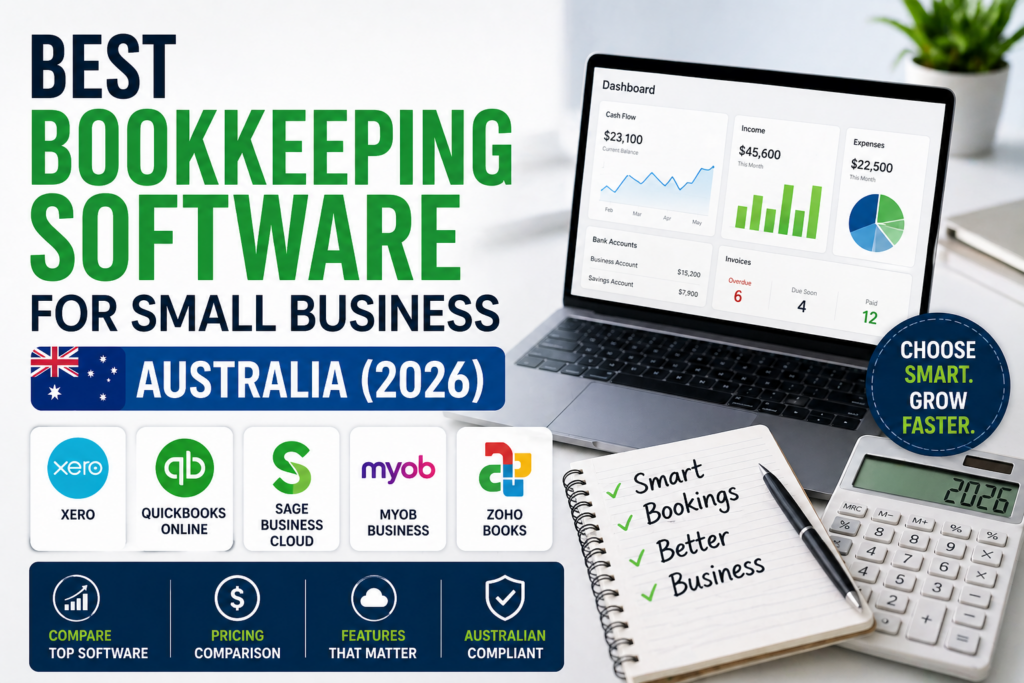
Best Bookkeeping Software for Small Business Australia (2026)
Table of Contents AI Overview Lead How to Choose the Right Bookkeeping Software (Decision Framework) The 8 Best Bookkeeping Software Platforms for Australian Small Businesses in 2026 Side-by-Side Comparison Table Best Bookkeeping Software for Specific Business Types Best Free Bookkeeping Software for Australian Small Businesses Best Bookkeeping Software for Self-Employed and Sole Traders Xero vs […]

5 Common Bookkeeping Mistakes Melbourne Small Businesses Make
From mixing personal and business expenses to missing GST deadlines, these mistakes could be costing you.

Why Xero is Australia’s Top Choice for Small Business Accounting
A deep dive into the features that make Xero the superior choice for cloud bookkeeping in 2024.